

Non-surgical rhinoplasty can change certain irregularities and proportions of the nose. Hyaluronic acid is placed selectively to balance particular contours by adding volume. Whether this treatment suits your concerns depends on the shape of your nose, your skin, any previous procedures and the findings of a medical examination.
Our aesthetic guide is a natural-looking nose that suits the individual face and respects its distinctive features. A single ideal or a nose modelled on social media does not determine planning at Mc Aesthetics.
The nose shapes both the front view and the profile of the face, so even a small change may be noticeable. The consultation aims to identify a change that suits your existing facial features. A particular desired shape cannot be achieved for everyone. A careful consultation also leaves room to decide against treatment.
 01 Film simulation
Watch simulation0:10
01 Film simulation
Watch simulation0:10
EXPLORE YOUR WISHES
Your profile. Your vision.
A short film as a starting point for your own wishes. Then explore different contours in the interactive preview.
Explore your own visionAn illustrative simulation, not a documented treatment result. This visualisation does not predict an individual outcome.
02Explore your own visionExplore contours · add your photos · prepare a consultation
YOUR VISION · TRY IT HERE
How would you like to look?
Move the sliders to explore a direction that feels right for you. Then add your own photos using the framing guide and enter your contact details.
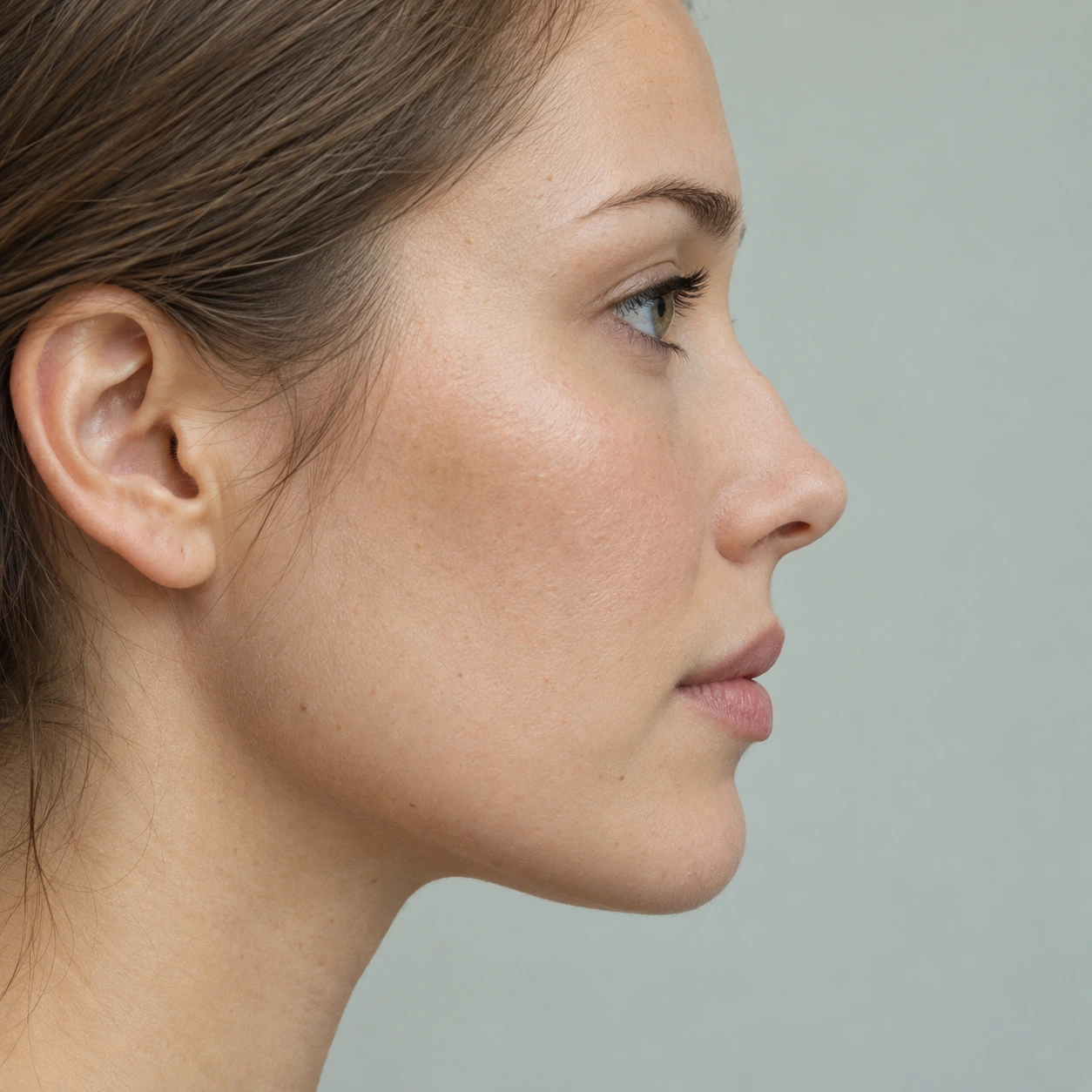 Generated visual example
Preview → Guided photos → Contact details. Every step is optional.
Open the full visual guideWhat can hyaluronic acid change about the shape of the nose?
A filler can fill small depressions and change the transitions along the nasal bridge. In a suitable case, this may make a hump less noticeable in profile or create a more even contour. The key question is which changes are actually possible by adding volume.
Hyaluronic acid removes neither bone nor cartilage. It does not actually make the nose smaller or narrow its bony framework. Visual balancing must therefore be distinguished from surgical reduction. More substantial shape changes, structural problems or restricted nasal breathing may require a different medical assessment.
For a closer look at the differences, see surgical rhinoplasty and the limitations of non-surgical rhinoplasty.
Hyaluronic acid, fillers and local anaesthesia
Hyaluronic acid occurs naturally in the body and can bind water. Injections use fillers manufactured for this purpose. The product is selected according to the treatment area, its properties and your individual circumstances. The fact that the underlying substance occurs in the body does not make an injection risk-free.
Some products contain lidocaine for local anaesthesia. Whether additional pain relief would be useful is discussed before treatment. Tell the clinician about allergies, intolerances and any previous reactions to fillers or anaesthetics. Completely pain-free treatment cannot be promised.
Who might this procedure suit?
Suitability can only be assessed after an in-person examination. Alongside the changes you would like, the clinician considers your skin, blood supply, previous filler injections and any medical conditions. Treatment is not automatically suitable for every nose or at every age.
Noses that have already undergone surgery or filler treatment need particular attention. Scarring and altered tissue can make planning more complex. Please give details of previous procedures, including when they took place, what was done and, if known, which product was used. Another filler injection is not an automatic way to correct the outcome of earlier surgery.
Inflammation, acute symptoms or problems breathing through the nose require medical assessment. Aesthetic filler injections do not replace treatment for functional problems. Whether a non-surgical correction, an operation or no procedure is the right choice is discussed in light of your individual findings.
Mc Aesthetics · KNOWLEDGE
Research, explained
A relevant original study, its measurements and its limits. The findings describe studied groups, not your personal outcome.
Who is behind a satisfaction rate?
Of 33 participants, 28 provided answers at eight months. Of those, 22 were satisfied or very satisfied with the result.
Number of participants

22 of 28 respondents = about 79%. These are nested groups.
How to read this chart Satisfaction describes this small responding group. Missing responses and potential risks are not explained by the rate.
Data & study design
A nasal hump and irregularities along the bridge
A nasal hump is often most noticeable from the side. In selected cases, filling nearby depressions can make the profile appear smoother. The hump itself is not removed. The extra volume may also make the nose larger overall.
The profile, front view and overall proportions are therefore assessed together. A change that looks appropriate from one angle may not suit another. Fillers cannot compensate for pronounced humps, marked asymmetry or structural changes without limits.
A drooping nasal tip and a hooked nose
A drooping nasal tip can have different causes. Its shape is influenced by cartilage, soft tissue and the relationship between the columella and the upper lip, among other factors. Movement when speaking or laughing can also affect its appearance.
Whether a targeted change with filler is possible and appropriate must be assessed individually. The procedure does not replace surgical reshaping of the nasal tip. Additional procedures, such as treating particular muscles with botulinum toxin, are separate medical decisions requiring their own assessment of suitability and risks.
You can read more about nasal tip correction and a hooked nose.
Saddle nose, a long nose and a broad nasal bridge
A saddle nose has a depression along the nasal bridge. It can have several causes and may involve changes to the supporting structures. Before aesthetic treatment, it is necessary to establish whether a purely visual correction is appropriate or whether structural or functional treatment is needed.
For a nose that appears long, changing particular transitions may affect how its proportions are perceived. Adding filler does not, however, shorten its actual length. Hyaluronic acid also cannot narrow a broad bony nasal framework. The consultation should make this distinction between visual appearance and an actual change in size clear.
How is the treatment prepared?
The consultation starts with your wishes and the specific change you have in mind. The doctor responsible examines your nose and assesses it in relation to the rest of your face. Previous treatments, medication, allergies and relevant medical conditions are included in your medical history.
Photographs or a simulation can help you discuss your goals. They illustrate a possible idea, but do not reliably predict the eventual result. Before you decide, the proposed product, alternatives, possible side effects and aftercare are explained. Any outstanding questions should be resolved before treatment.
Do not change or stop your medication on your own, particularly blood-thinning medication. Any necessary changes must be agreed with the doctor treating you and, where appropriate, the doctor who prescribed it.



What happens during non-surgical rhinoplasty?
After the procedure and its risks have been explained, the skin is cleaned and disinfected. The doctor responsible identifies the areas to treat and introduces the selected product using suitable instruments. The contour is checked repeatedly during treatment. This does not imply a standard amount of filler for everyone.
The injection itself may be relatively brief, but extra time is needed for consultation, preparation and checks. The sequence depends on the individual findings. An initial change may be visible straight away, although swelling or bruising can initially affect assessment of the result.
How much hyaluronic acid is needed?
The amount needed depends on your anatomy, the treatment goal, the product and any previous treatments. There is no single amount that suits every nose. More filler does not automatically produce a more balanced result and may add unwanted volume.
Planning should therefore start with the desired change and whether it is medically appropriate. A cautious approach over several steps may be useful in some cases; this is decided individually. Another session takes place only after reassessment and is not automatically part of every treatment.
What are the risks and side effects?
Possible effects include swelling, redness, bruising, pain, infections, lumps and asymmetry. Intolerance reactions and an aesthetically unsatisfactory result are also possible. Experience and careful preparation do not eliminate these risks completely.
An unintended injection into a blood vessel can impair blood flow. Rare but serious complications include tissue damage and visual disturbances, including loss of vision. The nose requires particular care because of its vascular connections. How complications would be managed must therefore be discussed during your consultation.
Unusually severe pain, noticeably pale or dark skin discolouration, and visual disturbances during or after an injection need immediate medical assessment. Do not wait for a routine follow-up appointment if these symptoms occur.
Aftercare, glasses, make-up and exercise
You will receive an aftercare plan tailored to the treatment and a contact for questions. Pressure on the treated areas, for example from glasses, as well as make-up, exercise, sauna use and intense heat are discussed specifically. General timeframes do not replace these individual recommendations.
Swelling and bruising can temporarily affect everyday life. An immediate return to all activities cannot be promised for everyone. Do not massage or reshape the treated nose yourself. The need for a check-up and its timing are agreed with the doctor responsible.
How long does the result last?
Hyaluronic acid breaks down over time. How long a change remains visible depends on factors including the product, the tissue and your individual response. A fixed duration therefore cannot be given for every treatment.
Repeated injections do not automatically create a permanent result. Before a top-up, the current contour, any remaining material and your personal goal are reassessed. It may also be appropriate to change the original plan or decide against further treatment.
Is cortisone an alternative?
Cortisone is not a general method for aesthetically reducing a healthy nose. Certain medical situations, such as after an operation, may need a separate specialist assessment. This does not support a general recommendation for nasal correction. Such treatment must not be equated with adding volume through hyaluronic acid.
Before-and-after images and personal expectations
Images can illustrate different starting points and changes. However, lighting, camera angle, the timing of the photograph and swelling all affect how a result appears. An image of someone else’s treatment is therefore not a template that can be transferred unchanged to your own nose.
An in-person examination clarifies which changes are realistic for you. Use personal accounts and images as a starting point for questions. Your own decision should rest on a clear explanation of the possibilities, limitations and risks.
Locations and enquiries
Mc Aesthetics has been present since 2013. Our locations are in Berlin, Munich, Düsseldorf, Hamburg, Frankfurt, Cologne, Stuttgart, Vienna, Zurich and Amsterdam. In Berlin, you can find us at Kurfürstendamm 15; in Munich, on Ludwigstraße. The specific venue and the doctor responsible are arranged individually for your enquiry.
For a personal enquiry, contact us at Contact form or via Verify WhatsApp access. Further details are available under locations and directions. The following topic section brings together individual questions and further articles about rhinoplasty.
 Questions & guidesNon-surgical rhinoplasty — Dortmund